
Featured CRGO Silicon Steel & Core Supply Catalog
Direct factory procurement for transformer core assembly, electrical laminations, structural steel, and precision industrial coils.



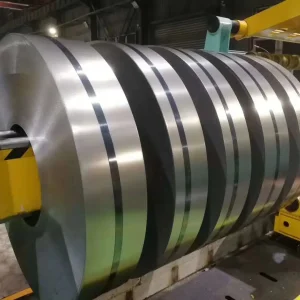
Executive Overview: Understanding CRGO Core Iron Physics & Grain Orientation
How Cold-Rolled Grain-Oriented (CRGO) electrical steel dictates efficiency, thermal management, and noise profiles in power transformer core iron structures.
In the modern power generation, transmission, and distribution ecosystem, Cold-Rolled Grain-Oriented (CRGO) electrical silicon steel represents the absolute benchmark material for manufacturing magnetic cores in distribution transformers, power transformers, step-up/step-down sub-station units, and high-efficiency reactors. Unlike non-oriented silicon steel (CRNGO) which features isotropic magnetic properties suited for rotating electrical machines (electric motors and generators), CRGO is precisely engineered to exhibit highly anisotropic magnetic properties. This anisotropy is concentrated along the rolling direction (RD), yielding exceptional magnetic permeability and minimal core hysteresis loss when the magnetic flux aligns with the grain structure.
The foundational mechanism behind high-grade core iron performance is the formation of the Goss Texture—specifically designated as the {110}<001> crystallographic orientation. Through rigorous multi-stage cold rolling, high-temperature secondary recrystallization annealing in hydrogen-nitrogen atmospheres, and precise thermal-chemical processing, iron-silicon alloy grains are forced to align seamlessly with their easy-magnetization axes ([001] direction) parallel to the length of the strip. Consequently, electrical transformer cores constructed with wholesale CRGO steel sheets achieve dramatically reduced excitation current, high magnetic flux density ($B_{8000} \ge 1.88\text{ to }1.95\text{ Tesla}$), and extremely low specific core losses ($P_{1.7/50} \le 0.80\text{ to }1.05\text{ W/kg}$).
Low Hysteresis Loss
Optimized magnetic domain alignment minimizes domain wall pinning forces, reducing hysteresis loop area and heat dissipation during alternating AC magnetic cycles.
Domain Refinement (Laser Scribed)
Advanced laser or mechanical scribing splits primary 180° magnetic domains into narrower sub-domains, drastically suppressing eddy current losses at high flux densities.
Low Magnetostriction & Noise
Tight crystallographic orientation limits physical dimensional changes during AC excitation, directly mitigating acoustic hum in urban transformer installations.
Global Procurement Demand for Wholesale CRGO Core Iron Suppliers
Macroeconomic drivers, renewable energy expansion, and power grid modernization pushing demand for high-grade electrical steel coils and core assemblies.
As global energy transition policies enforce strict eco-design energy efficiency standards—such as the European Union EcoDesign Directive (Tier 2 / EN 50708), the US Department of Energy (DOE 2026 Standards), and equivalent international mandates—electrical utilities and original equipment manufacturers (OEMs) can no longer rely on conventional carbon steel or low-grade silicon steel for transformer magnetic cores. The demand for wholesale CRGO electrical silicon steel coils has surged exponentially across four primary global vectors:
1. Power Grid Modernization & UHV Infrastructure
Aging electrical grids across North America, Europe, and Latin America are undergoing comprehensive overhaul. Ultra-High Voltage (UHV) transmission networks ($1000\text{ kV}$ AC / $\pm 800\text{ kV}$ DC) require massive power transformers built with ultra-low loss high-permeability CRGO (Hi-B steel) capable of continuous operation without thermal degradation or excessive core excitation losses.
2. Solar Inverters, Wind Farm Substations & EV Charging
Utility-scale solar power plants, offshore wind farms, and high-power DC fast-charging networks for electric vehicles demand dedicated step-up distribution transformers. These units operate under dynamic load profiles, harmonic distortions, and high environmental stresses, necessitating laser-scribed CRGO core iron with superior heat dissipation and stable magnetic permeability.
3. AI Data Center Power Density Expansion
Hyperscale artificial intelligence data centers consume vast megawatt-capacities. To minimize power usage effectiveness (PUE) ratios, data center operators mandate dry-type distribution transformers fitted with precision-slitted CRGO step-lap core stacks that dramatically lower standby core losses during low-load intervals.
4. Industrial Drives & Custom Reactor Fabrication
Heavy industrial plants, steel mills, and electric arc furnace facilities utilize specialized filter reactors, smoothing chokes, and variable-frequency drive transformers. Wholesale CRGO strips with customized thickness ($0.18\text{ mm to }0.30\text{ mm}$) provide tailored saturation flux densities and electrical insulation for high-frequency magnetic applications.
CRGO Electrical Steel Core Iron Technical Grade Standard
Comprehensive engineering metrics for conventional, high-permeability (Hi-B), and laser-refined CRGO silicon steel coils across global international standards.
| Steel Grade Category | Nominal Thickness | IEC 60404-8-7 Standard | Max Core Loss ($P_{1.7/50}$) | Min Induction ($B_{8000}$) | Primary Industrial Applications |
|---|---|---|---|---|---|
| Laser Refined Hi-B CRGO | 0.18 mm / 0.20 mm | 18NV070 / 20NV075 | 0.65 – 0.75 W/kg | ≥ 1.92 Tesla | Ultra-efficient Power Transformers, UHV Grids, AI Data Center Dry Transformers |
| High Permeability (Hi-B) CRGO | 0.23 mm | 23QG085 / 23HP85 | 0.80 – 0.85 W/kg | ≥ 1.90 Tesla | High-Efficiency Distribution Transformers, Solar Inverters, Oil-Immersed Cores |
| High Permeability (Hi-B) CRGO | 0.27 mm | 27QG095 / 27HP95 | 0.90 – 0.95 W/kg | ≥ 1.89 Tesla | Standard Distribution Transformers, Industrial Sub-station Transformers |
| Conventional CRGO Steel | 0.27 mm | 27M120 / M4-27 | 1.10 – 1.20 W/kg | ≥ 1.85 Tesla | Commercial Transformer Cores, Voltage Regulators, Grounding Reactances |
| Conventional CRGO Steel | 0.30 mm | 30M130 / M5-30 | 1.20 – 1.30 W/kg | ≥ 1.83 Tesla | General Electrical Machinery, Current Transformers, Standard Core Iron Stacks |
| Non-Oriented Silicon Steel (CRNGO) | 0.35 mm – 0.50 mm | M310-35A / M470-50A | 2.30 – 4.70 W/kg | ≥ 1.60 Tesla | EV Motors, Hermetic Compressors, Rotating Generators, Stator/Rotor Laminations |
* Note: Core loss ($P_{1.7/50}$) measured at $1.7\text{ Tesla}$ magnetic flux density and $50\text{ Hz}$ frequency using standard Epstein frame testing procedure (IEC 60404-2). Insulation coatings available in C-5 (Phosphate base with organic binder) and C-6 (Inorganic high temperature resistant) specifications.
Precision Manufacturing Lifecycle of Wholesale CRGO Coils & Core Iron
From liquid iron refining to laser domain scribing: How mill-direct quality assurance ensures exact dimensional and magnetic tolerances.
Steel Melting & Vacuum Degassing
Ultra-clean iron refining in basic oxygen furnaces combined with RH vacuum degassing to lower carbon content below $0.003\%$ and optimize silicon alloying ($2.9\%\text{ to }3.4\%\text{ Si}$) for maximum electrical resistivity.
Precision Cold Rolling & Decarburization
Multi-pass Sendzimir cold rolling mills reduce strip thickness down to ultra-thin gauges ($0.18\text{ mm to }0.30\text{ mm}$) with thickness tolerances controlled within $\pm 0.005\text{ mm}$ across the entire coil width.
High-Temp Box Annealing (HTBA)
Coils undergo high-temperature secondary recrystallization annealing at over $1200^\circ\text{C}$ in pure hydrogen atmospheres, driving complete Goss texture crystallographic alignment and removing sulfur and nitrogen impurities.
Laser Scribing Domain Refinement
High-speed fiber laser scribing systems introduce local thermal stresses perpendicular to the rolling direction, dividing domain spacing to reduce anomalous eddy current loss by up to $20\%$.
Tension Coating & C-5 Insulation
Inorganic magnesium-phosphate insulation coating is applied under tension, conferring high surface electrical resistance ($> 50\ \Omega\cdot\text{cm}^2/\text{lamination}$), excellent oil resistance, and extra tensile stress for loss reduction.
Precision Slitting & Burr-Free Edge Control
High-precision CNC slitting lines process full-width coils into custom strip widths ($20\text{ mm to }1000\text{ mm}$) while keeping edge burr heights strict strictly below $0.01\text{ mm}$ to prevent core inter-lamination short circuits.
Macro Industry Solutions: Step-Lap Cores, Wound Cores & Lamination Supply
Tailored wholesale CRGO supply models supporting transformer core factories with raw coil, slitted ribbon, cut-to-length laminations, and assembled core iron.
Mitigating No-Load Losses in Step-Lap Cores
No-load loss ($P_0$) represents a continuous cost for power utility grids over the 30+ year lifespan of a transformer. By upgrading core iron specifications from conventional CRGO ($30\text{M130}$) to laser-scribed high-permeability CRGO ($23\text{QG085}$ or $18\text{NV070}$) in a 7-step or 9-step-lap mitred joint core configuration, transformer engineers can achieve:
- Up to 30% reduction in No-Load Losses ($P_0$) compared to traditional butt-joint or 45° mitred stacked cores.
- Significant reduction in magnetizing kVA excitation due to streamlined flux path transition at core leg and yoke intersections.
- Acoustic noise attenuation by 4 to 8 dB(A), crucial for compliance with municipal suburban substation noise limits.
- Optimized Stacking Factor (≥ 98.0%): Flat coil strip shape and uniform C-5 coating thickness maximize magnetic steel volume inside the core window.
Compliance with Global Efficiency & CBAM Standards
Navigating international supply chain compliance requires full transparency regarding material carbon footprints and regional steel manufacturing origin. Direct factory procurement of CRGO steel coils from certified manufacturers provides concrete commercial advantages:
- Full Traceability & Mill Test Certificates (MTC): Every batch is accompanied by EN 10204 3.1 certification detailing chemical heat analysis, magnetic loss testing, and coating breakdown insulation resistance.
- EU CBAM Readiness: Complete embedded carbon emission data reporting to comply with European Carbon Border Adjustment Mechanism import requirements.
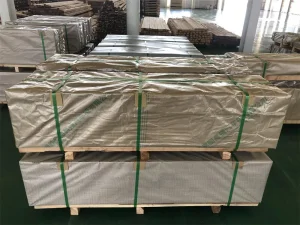
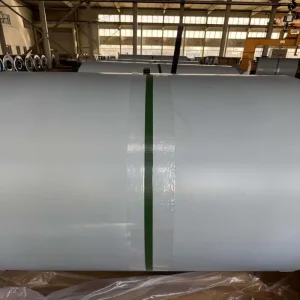
- Corrosion Protection for Overseas Transit: Coils and slitted packs are sealed in VCI (Volatile Corrosion Inhibitor) anti-rust film, heavy-duty metallic edge protectors, and seaworthy wooden/steel pallets.
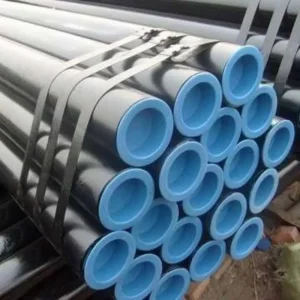
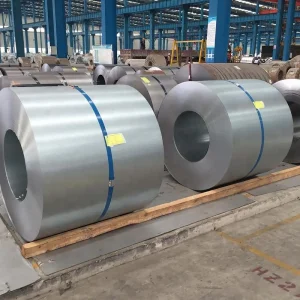
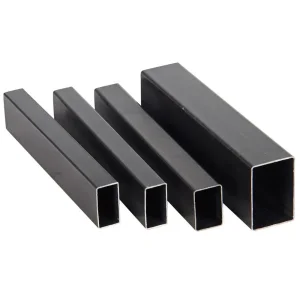
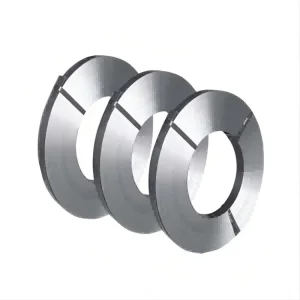
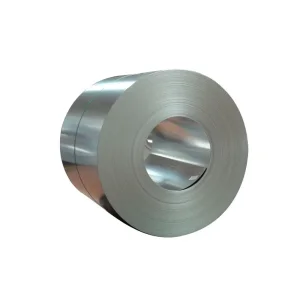
Industrial Steel Coils, Plates & Core Accessories
Full line industrial raw materials for transformer housing, solar brackets, agricultural structures, and structural steel framing.

Wholesale CRGO Core Iron Procurement & Engineering FAQ
In-depth technical answers addressing material selection, core loss testing, slitting tolerances, and mill-direct factory collaboration.
What is the structural and magnetic difference between CRGO and CRNGO silicon steel?
Cold-Rolled Grain-Oriented (CRGO) steel undergoes special thermo-mechanical processing to align iron-silicon crystals predominantly in one direction (the rolling direction), producing the Goss {110}<001> texture. This directional magnetic orientation results in extremely high magnetic permeability and ultra-low hysteresis loss along the length of the strip, making CRGO ideal for static magnetic devices like power transformers, distribution transformers, and reactors where magnetic flux flows linearly.
In contrast, Cold-Rolled Non-Oriented (CRNGO) steel features isotropic magnetic properties, meaning magnetic performance is uniform in all directions across the sheet plane. CRNGO is specifically manufactured for rotating electrical machinery—such as electric vehicle motors, industrial motor stators/rotors, generators, and hermetic compressor motors—where the magnetic flux rotates continuously through 360 degrees.
How does laser domain scribing reduce core loss in CRGO electrical steel?
Laser scribing is a state-of-the-art domain refinement technique. In high-permeability CRGO steel, 180° magnetic domains can become excessively wide, leading to elevated eddy current losses (specifically anomalous or excess eddy current loss) when operated at high magnetic flux densities ($1.7\text{ Tesla}$ to $1.9\text{ Tesla}$).
By scanning high-energy laser beams rapidly across the strip surface perpendicular to the rolling direction at precise intervals (typically $4\text{ mm}$ to $8\text{ mm}$ pitch), controlled micro-strains are induced into the crystal lattice. This thermal stress forces the large magnetic domains to subdivide into narrower domain walls. The narrower domain spacing drastically accelerates domain wall motion during high-frequency AC magnetization cycles, effectively lowering overall specific core losses ($P_{1.7/50}$) by 10% to 20% without damaging the protective surface insulation coating.
What slitting tolerances and burr height limits are required for core iron lamination production?
When slitting CRGO wide coils into narrow ribbons for transformer core stacking or wound core production, edge quality is critical. High edge burrs bridge adjacent steel laminations inside the assembled core, causing localized inter-lamination short circuits. These short circuits generate circulating eddy currents, leading to excessive hot spots, thermal runaway, and localized insulation degradation.
Our precision slitting lines maintain strict dimensional controls: strip width tolerance is held within $\pm 0.10\text{ mm}$ (or $\pm 0.05\text{ mm}$ upon request), camber is restricted to under $0.2\text{ mm}$ per $2000\text{ mm}$ length, and maximum edge burr height is guaranteed under $0.01\text{ mm}$ ($10\ \mu\text{m}$). Carbide slitting knives and automated tension control ensure burr-free edges ready for high-speed step-lap transformer stacking machines.
What insulation coatings are applied to wholesale CRGO core iron coils?
CRGO steel sheets receive inorganic tension coatings that serve dual functions: electrical insulation and mechanical stress inducement for loss reduction. The standard insulation specifications include:
- C-5 Coating (Magnesium Phosphate with Inorganic Fillers): The primary standard for transformer cores. Offers high inter-lamination electrical resistance ($> 50\ \Omega\cdot\text{cm}^2$), exceptional resistance to hot transformer oil ($150^\circ\text{C}$), and excellent punchability.
- C-6 Coating (Inorganic High-Temperature Coating): Designed for dry-type transformers or cores undergoing stress-relief annealing after punching/slitting. Withstands annealing temperatures up to $820^\circ\text{C}$ in neutral nitrogen atmospheres without peeling, flaking, or losing insulation properties.
What is the difference between Epstein frame testing and Single Sheet Testing (SST)?
Both methods measure specific core loss ($P$, $\text{W/kg}$) and magnetic induction ($B$, $\text{Tesla}$), but differ in execution and application:
Epstein Frame Testing (IEC 60404-2): The traditional international referee test method. Strips measuring $280\text{ mm} \times 30\text{ mm}$ are sheared from the coil along and across the rolling direction, loaded into a square test frame, and annealed to remove shearing stresses. It provides standardized, highly repeatable magnetic loss values used for formal mill test certification.
Single Sheet Testing (SST / IEC 60404-3): A non-destructive test method performed directly on full-width or full-length steel sheets without requiring sheared strip samples. SST is widely used during fast online manufacturing quality control and by transformer manufacturers to verify full-sheet magnetic uniformity prior to cutting and core stacking.
How are wholesale CRGO steel coils packaged for long-distance international ocean freight?
Electrical silicon steel is highly sensitive to moisture, oxidation, and mechanical impact. To guarantee zero surface rust or edge deformation upon arrival, our export packaging includes:
- Inner wrap with high-grade VCI (Volatile Corrosion Inhibitor) anti-rust film and waterproof barrier paper.
- Internal and external steel edge protectors along with circumferential high-strength steel strapping.
- Heavy-duty corrugated galvanized steel outer sleeve protection.
- Vertical (Eye-to-Sky) or Horizontal (Eye-to-Side) mounting on fumigated wooden pallets or customized steel skids with shock-absorbing rubber pads, rated for safe containerized ocean transport.
Can you supply custom cut-to-length step-lap CRGO laminations directly to transformer factories?
Yes. In addition to master wide coils and slitted coils, we operate fully automated Georg/CNC transformer core cutting lines capable of supplying pre-cut, V-notched, hole-punched, and step-lap mitred core laminations ($45^\circ$ cut angles). Transformer factories can receive ready-to-stack lamination packs customized to their core assembly drawings, significantly reducing raw material scrap rates, labor overhead, and factory floor processing time.
How do I request a formal quotation and mill sample for CRGO core iron?
You can submit your required technical specification—including target grade (e.g., $23\text{QG085}$, $27\text{QG095}$, $30\text{M130}$), coil or strip dimensions (thickness, width, coil ID/OD), total tonnage, coating type (C-5/C-6), and delivery destination port—via our engineering contact form or direct sales email. Sample coils, Epstein test strips, and mill test reports (MTC) are available for laboratory validation prior to commercial volume production.
Partner with a Direct Wholesale CRGO Core Iron Supplier Today
Enhance transformer energy efficiency, guarantee low core losses, and secure reliable supply chains for electrical steel coils, slitted ribbons, and engineered laminations.
Request Engineering Quote & MTC