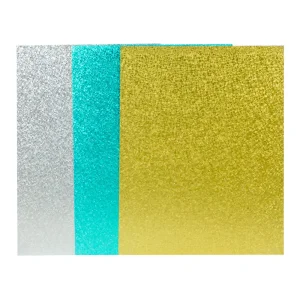
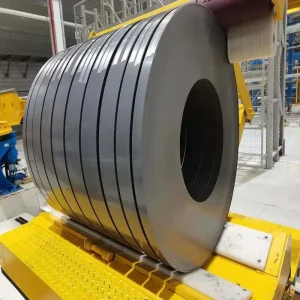
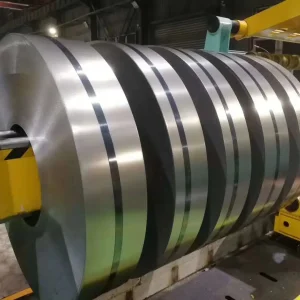
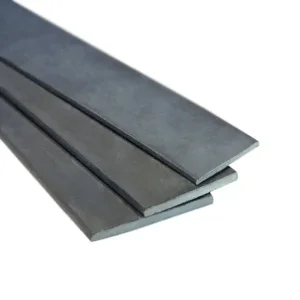
Featured Industrial Tubing & Precision Coated Products (Batch 1)
Direct mill supply catalog featuring pre-galvanized hollow sections, silicon-aluminized substrates, electrical silicon coils, and ultra-durable alloy coated sheet solutions.
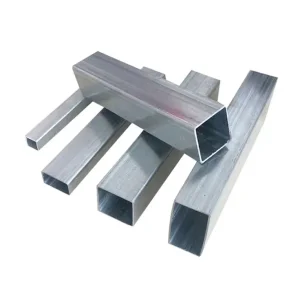
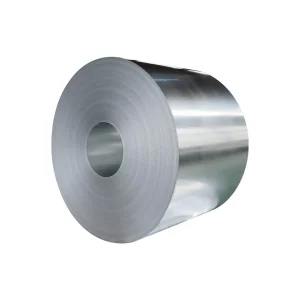
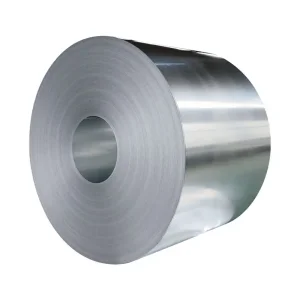


Metallurgical Engineering: Microstructure & Galvanizing Mechanics of 700 MPa Steel
An authoritative analysis of microalloyed thermo-mechanically controlled processing (TMCP), liquid metal embrittlement (LME) mitigation, and phase transformation kinetics in ultra-high yield structural tubing.
Thermomechanical Microalloying Mechanics
Achieving a minimum yield strength of 700 MPa (S700MC / S700GD / High-Strength Low-Alloy HSLA) in structural hollow sections demands precise microalloying chemistry paired with Thermo-Mechanically Controlled Processing (TMCP). By engineered additions of Niobium (Nb), Vanadium (V), and Titanium (Ti)—typically ranging from 0.02% to 0.12% total mass—the steel matrix develops fine-scale carbonitride precipitates ($Nb(C,N)$, $Ti(C,N)$). During hot rolling, these nano-precipitates pin austenite grain boundaries, suppressing grain growth and inducing extreme grain refinement. The resulting microstructure yields a homogeneous ultra-fine ferritic-bainitic or dual-phase matrix capable of maintaining supreme ductility ($\ge 12\%$ elongation) alongside structural resilience.
Interfacial Zinc-Iron Phase Kinetics
Galvanizing 700 MPa ultra-high strength steel tubes introduces complex interfacial reactions during continuous hot-dip baths ($440^\circ\text{C} - 460^\circ\text{C}$). The presence of high silicon ($Si \ge 0.15\%$) and manganese ($Mn \ge 1.60\%$) can induce the Sandelin effect, resulting in rapid, uncontrolled growth of brittle $Gamma (\Gamma)$ and $Delta (\delta)$ zinc-iron alloy layers. Our specialized manufacturing process utilizes a modified bath chemistry infused with 0.18%–0.25% dissolved Aluminum ($Al$) to form an instantaneous protective $Fe_2Al_5$ inhibition layer. This prevents excessive phase growth, ensuring superior zinc adhesion, crack-free bend performance, and high-velocity impact tolerance.
In high-tensile steels ($\ge 700\text{ MPa}$), atomic hydrogen absorption during chemical acid pickling ($HCl / H_2SO_4$) poses a catastrophic risk of delayed hydrogen-induced cracking (HIC). As a leading OEM factory, our production protocols integrate mandatory post-pickling thermal degassing at $180^\circ\text{C} - 210^\circ\text{C}$ prior to fluxing, coupled with ultra-low-stress high-frequency induction welding (HFIW). Furthermore, grain-boundary chemistry control prevents Liquid Metal Embrittlement (LME) during high-temperature galvanizing immersion.
Engineering Specification Matrix: 700 MPa Tubing vs Standard Structural Grades
Comprehensive mechanical, chemical, and dimensional compliance parameters for engineers, procurement directors, and EPC structural designers.
| Steel Grade & Designation | Yield Strength $R_{eH}$ (MPa) | Tensile Strength $R_m$ (MPa) | Min. Elongation $A_5$ (%) | Charpy V-Notch Impact ($J$) | Cold Bending Radius ($R/t$) | Galvanizing Suitability |
|---|---|---|---|---|---|---|
| 700MPa Tube (S700MC / S700GD) | ≥ 700 MPa | 750 - 950 MPa | ≥ 12% | ≥ 40 J at -40°C | ≥ 2.0t | HDG / Pre-Galv / ZM Alloys |
| S355J2H (EN 10210 / EN 10219) | ≥ 355 MPa | 470 - 630 MPa | ≥ 20% | ≥ 27 J at -20°C | ≥ 1.0t | Standard Hot-Dip Galvanized |
| Q235 / Q345 Structural Steel | 235 - 345 MPa | 370 - 510 MPa | ≥ 22% | ≥ 27 J at +20°C | ≥ 1.0t | Standard Electro / Hot-Dip |
| ASTM A500 Grade C (SHS/RHS) | ≥ 345 MPa (50 ksi) | ≥ 425 MPa (62 ksi) | ≥ 21% | Optional / Standard | ≥ 1.5t | Batch & Continuous Zinc Coating |
| High-Strength Solar Grade (ZM310) | ≥ 420 - 550 MPa | 500 - 680 MPa | ≥ 16% | ≥ 34 J at -20°C | ≥ 1.5t | Inline Zinc-Aluminum-Magnesium |
Macro Industrial Solutions: Driving Lightweighting & Decarbonization
Global commercial infrastructure demands thinner-walled, ultra-high-capacity structural members to slash steel consumption, freight expenditures, and carbon emissions.
High-Bay Logistics & Automated Warehousing
Modern AS/RS (Automated Storage and Retrieval Systems) demand extreme vertical stability with minimal foot-print column dimensions. Utilizing 700 MPa galvanized square and rectangular tubes (SHS/RHS) reduces rack system weight by up to 38%, allowing higher pallet stack density, lower foundation loading, and seamless integration with high-speed automated cranes.
Utility-Scale Solar Trackers & Mounting Structures
Solar torque tubes are subjected to extreme torsional stresses and dynamic wind loads. Transitioning from standard S355 to 700 MPa high-yield structural tubing enables single-axis trackers to achieve longer span distances between foundation piles, reducing total civil foundation costs while surviving $160+\text{ mph}$ gale forces.
Commercial Vehicles & Heavy Transport Trailers
In global transportation logistics, deadweight directly penalizes fuel efficiency and payload limits. 700 MPa galvanized structural hollow sections form the backbone of chassis side beams, container frames, and agricultural trailers, delivering unmatched impact resistance while lowering fleet carbon intensity.
Localized Deployment: Region-Specific Engineering & Compliance
Tailoring coating weights, dimensional tolerances, and structural certifications to regional environmental conditions and national building codes.
North America (ASTM A1046 / A653)
Designed to meet demanding UL, IBC, and AASHTO standards across North America. For extreme desert environments (Atacama, Nevada) and high-humidity coastal corridors, our 700 MPa tubes feature heavy-duty Zinc-Aluminum-Magnesium (ZM275/ZM310) coatings that surpass standard salt spray testing ($> 3,000$ hours to 5% red rust).
European Union (Eurocode 3 / EN 10219)
Fully compliant with EN 10219-1/2 (S700MC / S700GD) and CE marking requirements under CPR 305/2011. Optimized for strict European energy efficiency mandates in agricultural glasshouses, architectural space frames, and severe sub-zero Nordic operational conditions (-40°C Charpy V-notch verification).
Middle East & APAC Coastal Belts
Formulated for C4/C5 severe marine atmosphere classification (ISO 12944). High-salinity desert locations demand thick hot-dip galvanized profiles ($Z600 / 85\,\mu\text{m}$) accompanied by passivation pre-treatments that counteract micro-abrasion caused by airborne particulate sandstorms.
Technology Roadmap 2025–2030: Next-Gen Ultra-High Strength Tubing
Pioneering smart metallurgical monitoring, self-healing alloy coatings, and zero-carbon hydrogen-based steelmaking.
Self-Healing Zn-Al-Mg-Si Coating Alloys
Our R&D facility is rolling out third-generation Zinc-Aluminum-Magnesium-Silicon (ZM-Si) melt baths. When exposed to cut edges or punched holes, the alloy forms a dense, insoluble simonkolleite [$Zn_5(OH)_8Cl_2\cdot H_2O$] protective film that automatically heals sheared exposed steel edges without requiring secondary zinc spraying.
AI-Driven High-Frequency Induction Weld Quality Control
Integrating real-time infrared thermography with machine-learning feedback loops on our continuous tube mills. Every millimeter of the weld seam on 700 MPa hollow sections is digitally scanned for temperature variation, weld squeeze-out geometry, and internal seam flash consistency, ensuring 100% defect-free structural integrity.
Frequently Asked Questions (Technical & Commercial FAQ)
Direct, rigorous answers to critical technical questions regarding microalloying, welding parameters, bending radius, and international procurement logistics.
How does 700 MPa yield strength steel tube differ from standard structural S355 or Q345 grades?
Can 700 MPa high-yield galvanized steel tubes be welded on-site without losing structural integrity?
Is Hydrogen Embrittlement a risk during hot-dip galvanizing of 700 MPa steel tubes, and how is it mitigated?
What minimum cold bending radius ($R/t$) is required when fabricating 700 MPa structural tubes?
What zinc coating mass options are available for wholesale 700 MPa galvanized tube orders?
How do 700 MPa galvanized tubes perform under dynamic seismic and sub-zero impact loading?
What standard mill certifications and third-party inspection reports are provided with wholesale shipments?
Complementary High-Grade Coated Steel & Structural Products (Batch 2)
Explore our full industrial portfolio including Aluzinc panels, electrical grain-oriented silicon coils, electrogalvanized sheets, and stainless alloy grades.