
Featured Mill-Direct Steel & Coil Products
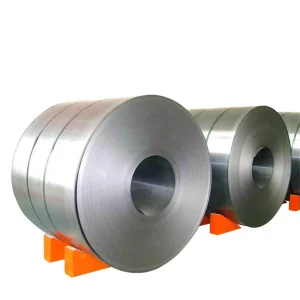
Explore our primary inventory of precision-rolled, galvanized, and alloy steel coils, strips, and structural components manufactured under strict ISO 9001 and ISO 14001 quality frameworks.



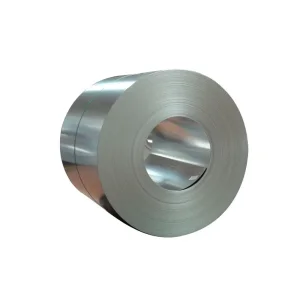
Micro-Structure & Coating Technology in Galvanized Steel Strips
Understanding the sacrificial oxidation dynamics, phase transformations, and mechanical slitting controls necessary for high-yield industrial applications.
Substrate Preparation and Continuous Hot-Dip Galvanizing Lines (CGL)
High-quality galvanized steel strip coils begin with rigorous substrate selection. Whether utilizing cold-rolled full-hard (CRFH) coils or pickling hot-rolled carbon steel coils (HRPO), raw materials undergo electrolytic alkaline degreasing, mechanical scrubbing, and multi-stage cascade rinsing to remove residual rolling lubricants and iron fines. The strip enters a non-oxidizing annealing furnace (NOF) maintained under a protective hydrogen-nitrogen reducing atmosphere (typically 5% to 15% H₂ balance N₂). Here, recrystallization annealing restores ductility while reducing surface oxides to metallic iron, ensuring atomic-level metal-to-metal contact inside the liquid zinc pot.
The molten zinc bath operates within a strict metallurgical window of 450°C to 460°C with controlled effective aluminum additions (0.15% to 0.20% Al). As the steel strip passes through the bath, an instantaneous solid-state diffusion reaction forms a microscopic Fe-Al intermetallic barrier layer (Fe₂Al₅ and FeAl₃). This inhibition layer prevents excessive, brittle iron-zinc alloy phase growth (Gamma, Delta, and Zeta phases), imparting superior coating adhesion required for severe bending, roll-forming, and deep drawing.
Macro Industry Solutions & Commercial Landscape
Analyzing global demand shifts, supply chain vulnerabilities, and regional decarbonization mandates impacting galvanized strip coil procurement.
Renewable Energy Infrastructure
Solar photovoltaic (PV) utility scale projects require specialized C/Z purlins and ground-mount trackers capable of enduring 25+ years in harsh soil and salt-spray microclimates. The industry is rapidly shifting from post-galvanized structural channels to pre-galvanized high-yield strip coils (S350GD, S450GD, and S550GD) featuring heavy zinc (Z450-Z600) or Zinc-Aluminum-Magnesium (Zn-Al-Mg) coatings. This transition reduces field welding, cuts logistics costs by up to 18%, and eliminates field galvanizing bottlenecks.
HVAC & Air Handling Ductwork
In modern industrial and commercial building projects, lock-forming quality (LFQ) galvanized steel strips compliant with ASTM A653 CS Type B or EN 10346 DX51D are critical for spiral ductwork, cable trays, and fire dampers. Smooth surface finishes, zero-spangle options, and environmentally compliant dry/oiled passivation prevent flaking or cracking along lock-seams during high-speed mechanical flanging.
Automotive & Precision Stamping
Automotive Tier-1 fabricators require slit strip coils with razor-thin width tolerances (±0.05mm) and strict camber control (<1.5mm per meter). High-strength low-alloy (HSLA) galvanized steel strips allow vehicle weight reduction without sacrificing crashworthiness. Electro-galvanized (EG) and hot-dipped galvanized coils serve interior body panels, seat channels, and battery enclosure framing for electric vehicles (EVs).
International Standard & Mechanical Grade Breakdown
Cross-referencing global standards to streamline procurement and engineering validation across multi-regional tenders.
| Standard | Steel Grade | Yield Strength (MPa) | Tensile Strength (MPa) | Elongation A80 (%) | Primary Application Scenarios |
|---|---|---|---|---|---|
| ASTM A653 / A653M | CS Type A / B / C | 205 - 380 | 270 - 500 | ≥ 20 | General sheet metal forming, HVAC ducts, light framing |
| ASTM A653 / A653M | SS Grade 330 (33) / 50 | ≥ 230 / ≥ 340 | ≥ 310 / ≥ 450 | ≥ 18 / ≥ 12 | Load-bearing structural purlins, metal deck building panels |
| EN 10346 | DX51D + Z / ZF | 140 - 300 (Proof) | 270 - 500 | ≥ 22 | Lock-forming quality, profile bending, enclosure cabinets |
| EN 10346 | S350GD + Z / ZM | ≥ 350 | ≥ 420 | ≥ 16 | Heavy solar PV racking, highway guardrails, structural C/Z channels |
| JIS G3302 | SGCC / SGCD1 | 205 - 300 | ≥ 270 | ≥ 30 | Commercial stamping, deep-drawn appliance components |
| JIS G3302 | SGH400 / SGH540 | ≥ 295 / ≥ 400 | ≥ 400 / ≥ 540 | ≥ 18 / ≥ 12 | Industrial roofing, high-load warehouse racking profiles |
Coating Weight vs. Atmospheric Service Life Expectancy
Corrosion performance of hot-dip galvanized strip coil is directly proportional to zinc coating mass, dictated by atmospheric aggressiveness zones classified under ISO 9223 (C1 to C5/CX). Below is an engineering estimate of years to first major maintenance (5% red rust appearance):
C3 Industrial (Outdoor): 8-12 Years
C4 Heavy Industrial: 12-18 Years
C5 Extreme Offshore: 15-22 Years
Localized Edge Protection & Quality Compliance
How high-speed precision slitting impacts the cut-edge cathodic protection mechanism of galvanized steel strips.
Cathodic Galvanic Protection at Slit Edges
When master galvanized coils are slit into narrow strips (e.g., 20mm to 600mm widths), the bare steel core is exposed along the sheared edge. A common misconception in steel procurement is that ungalvanized cut edges will rapidly rust and cause structural failure. However, zinc exhibits a lower electrode potential (-0.76V vs. SHE) than iron (-0.44V vs. SHE).
In the presence of atmospheric moisture, an electrochemical cell forms where the surrounding zinc coating acts as an anode, sacrificially corroding to protect the cathodic exposed steel edge. Over time, insoluble zinc oxidation byproducts—primarily basic zinc carbonate [Zn₅(CO₃)₂(OH)₆]—precipitate over the cut edge, creating a secondary physical barrier that seals the cut margin against localized red rust creep.
Slitting Tolerance & Edge Quality Control Checklist
- Burr Height Limits: Maintained under 5% of total strip thickness using carbide rotary slitting knives to prevent coating abrasion during uncoiling.
- Camber Control: Maximum 1.0mm per 2000mm length, eliminating jam-ups in roll-forming dies and automated punching presses.
- Coil Tensioning: Automated hydraulic recoilers with paper interleave options prevent friction scratches and fretting corrosion in marine transport.
- Oil & Passivation Surface Treatments: Environmentally safe trivalent chromium (Cr3+) or zero-chromate organic sealing to pass 72-hour white rust salt spray tests (ASTM B117).
Next-Generation Metallic Coatings & Decarbonization
Pioneering eco-friendly passivation and ultra-high durability alloys for 2026 and beyond.
Zinc-Aluminum-Magnesium (Zn-Al-Mg) Evolution
Ternary alloy coatings containing 1.5% to 3% Magnesium and 3% to 11% Aluminum represent the most significant leap in coated flat steel over the past three decades. Magnesium promotes the formation of Simonkolleite [Zn₅(OH)₈Cl₂·H₂O], a dense, tight-adhering protective layer that offers 5x to 10x the corrosion resistance of standard hot-dip galvanized steel at equivalent coating weights. Crucially, Zn-Al-Mg self-heals slit edges significantly faster, eliminating the need for post-slitting touch-up coatings in harsh agricultural or coastal applications.
Decarbonized "Green Steel" Substrates
To comply with CBAM (Carbon Border Adjustment Mechanism) in Europe and global ESG corporate benchmarks, steel mills are transitioning from blast furnace (BF-BOF) routes to Electric Arc Furnace (EAF) steelmaking fueled by Direct Reduced Iron (DRI) and green hydrogen. Our factory line roadmaps incorporate scrap-certified, low-embedded-carbon hot-rolled and cold-rolled substrates, reducing Scope 1 and Scope 2 emissions by up to 60% per ton of finished galvanized strip coil.
Smart Factory Slitting & Inspection AI
Integrating high-resolution optical surface defect scanners along continuous slitting lines allows real-time automated detection of zinc dross inclusions, pinholes, edge burrs, and coil tension variations. Combined with laser profile gauge thickness monitoring, every slit strip coil is delivered with a complete digital quality twin linked directly to its Mill Test Certificate (MTC).
Industrial Pipes, Coils & Electrical Steel Solutions
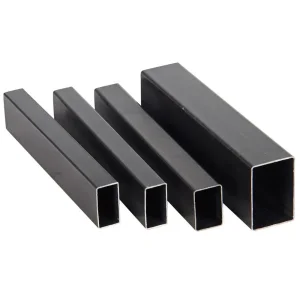
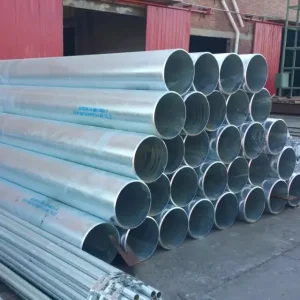
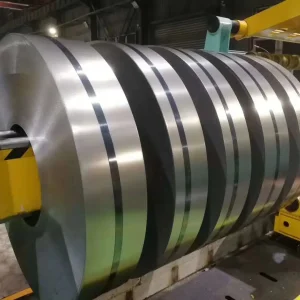
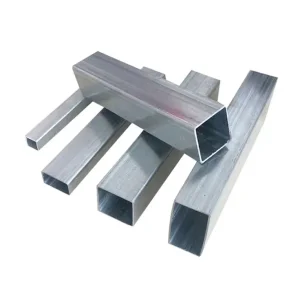
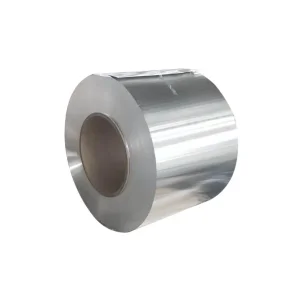
Beyond strip coils, explore our mill-direct spiral pipes, electrical silicon steels, tinplate, and structural hollow sections.


Frequently Asked Technical Questions
Detailed answers addressing international procurement standards, metallurgical testing, ocean transport packaging, and slitting limits.
How do you prevent white rust (wet storage stain) during long ocean transit?
White rust forms when galvanized strip coils are exposed to trapped moisture in low-oxygen environments (such as sealed ocean containers). We prevent this through a multi-layer protective protocol: 1) Applying an environmentally compliant trivalent chromate or zero-chromate passivation film; 2) Applying light electrostatic rust-inhibiting oil (1.0 to 2.5 g/m²); 3) Wrapping coils in waterproof VCI (Vapor Corrosion Inhibitor) paper; and 4) Utilizing heavy-duty steel outer eye-vertical/eye-horizontal palletized packaging with desiccants.
What is the minimum slit width and thickness tolerance available for galvanized steel strip coils?
Our precision precision slitting lines accommodate strip widths from 15mm up to 600mm, with thickness capabilities spanning 0.12mm to 4.0mm. Width tolerances are held strictly to ±0.05mm for high-precision stamping lines, while thickness tolerances comply with EN 10143 fine tolerances (±0.02mm to ±0.04mm depending on gauge).
Which zinc spangle type should be specified for post-painting or roll forming?
For post-painted applications (such as architectural cladding or home appliance panels), zero-spangle (extra-smooth skin-passed) strip coil is recommended. Zero-spangle surfaces eliminate visual spangle shadow through organic powder coatings. Regular spangle is cost-effective for unpainted structural C/Z purlins, cable trays, and agricultural framing where aesthetics are secondary to raw zinc barrier thickness.
Can galvanized steel strip coils be directly welded without removing the zinc coating?
Yes, but specific welding parameters must be adopted. High-frequency induction welding (HFW) and spot welding are standard. For manual MIG/TIG welding, zinc vaporizes at 906°C—well below steel's melting point of 1500°C—which can cause weld porosity and zinc oxide fume inclusion. We recommend using zinc-rich primer touch-ups (compliant with ISO 1461) over weld seams to restore localized corrosion protection.
What documentation and certifications are provided with each export shipment?
Every batch is supplied with an official EN 10204 3.1 Mill Test Certificate (MTC) detailing ladle chemical analysis (C, Mn, P, S, Si, Al), mechanical properties (Yield, Tensile, Elongation), coating mass test results (triple spot test), and dimensional inspection logs. Third-party inspections by SGS, Bureau Veritas, or Intertek can be conducted at the port of loading upon request.