Featured Industrial Products & Steel Solutions
Direct Mill Supply Chain Options: Coated Steel Coils, Galvanized Systems, and Electrical Silicon Steels
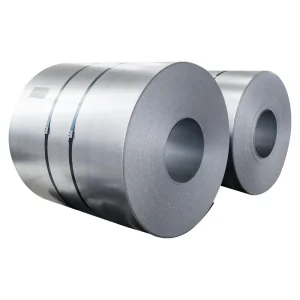
Deconstructing 23/110 CRGO: Nomenclature, Metallurgy & Electromagnetics
Understanding the exact physical parameters, domain refinement mechanisms, and performance metrics of 0.23mm ultra-low loss grain-oriented electrical steel.
In the high-stakes engineering of modern power systems, Cold Rolled Grain Oriented (CRGO) electrical steel serves as the essential magnetic core material for transformers, reactors, and high-efficiency inductors. Among the available industrial grades, 23/110 CRGO represents an advanced benchmark of energy efficiency and electromagnetic performance. The designation "23/110" follows internationally standardized naming conventions (such as IEC 60404-8-7 and EN 10107), where "23" denotes a nominal sheet thickness of 0.23 mm (0.009 inches), and "110" signifies a guaranteed maximum core loss (iron loss) of 1.10 Watts per kilogram measured at a magnetic flux density of 1.7 Tesla at a frequency of 50 Hertz.
The Crystallographic Physics Behind Goss Texture (110)[001]
The exceptional performance of 23/110 CRGO relies on achieving a near-perfect sharp crystallographic orientation known as the Goss texture, designated in Miller indices as (110)[001]. During the specialized cold rolling and secondary recrystallization annealing processes conducted at state-of-the-art Chinese steel manufacturing complexes, iron-silicon alloy grains (containing approximately 3.0% to 3.4% Silicon) are precisely aligned. The [001] easy-magnetization direction of the cubic crystal lattice is oriented parallel to the rolling direction of the steel strip.
By controlling impurity precipitates (such as Manganese Sulfide, MnS, or Aluminum Nitride, AlN) which act as grain growth inhibitors, top-tier Chinese CRGO factories force the secondary recrystallization growth to favor strictly oriented grains. As a result, when an alternating magnetic field is applied along the rolling direction, the magnetic domain walls move with minimal friction, drastically reducing hysteresis loss and requiring exceptionally low magnetizing currents.
| CRGO Grade Spec | Nominal Thickness | Max Core Loss @ 1.5T/50Hz (W/kg) | Max Core Loss @ 1.7T/50Hz (W/kg) | Min Magnetic Induction B800 (Tesla) | Density (g/cm³) | Stacking Factor (%) |
|---|---|---|---|---|---|---|
| 23/110 (Laser Refined) | 0.23 mm | 0.72 - 0.78 | 1.00 - 1.10 | 1.89 - 1.92 | 7.65 | ≥ 95.5% |
| 23/120 (Standard Orientation) | 0.23 mm | 0.80 - 0.85 | 1.12 - 1.20 | 1.88 - 1.90 | 7.65 | ≥ 95.5% |
| 27/120 (Conventional CRGO) | 0.27 mm | 0.82 - 0.88 | 1.15 - 1.20 | 1.86 - 1.88 | 7.65 | ≥ 96.0% |
| 30/130 (Standard Core Grade) | 0.30 mm | 0.88 - 0.95 | 1.22 - 1.30 | 1.85 - 1.87 | 7.65 | ≥ 96.5% |
Laser Scribing & Domain Refinement Technology
To push 0.23mm steel down to a guaranteed core loss threshold of 1.10 W/kg or lower, leading Chinese manufacturers employ online laser domain refinement (laser scribing). High-energy fiber lasers scan across the surface of the moving steel strip at precise intervals perpendicular to the rolling direction. This optical thermal treatment introduces local micro-stresses into the crystal lattice, breaking wide main magnetic domains into narrower, closely spaced sub-domains. Narrower domains reduce the velocity at which domain walls must move during high-frequency electrical magnetizing cycles, effectively slashing eddy current losses by up to 15-20% without damaging the protective inorganic insulation coating.
China's Manufacturing Supremacy in 23/110 CRGO Production
How Chinese steel mills have integrated raw material smelting, high-precision cold rolling, and advanced surface coating to deliver cost and quality advantages globally.
Fully Integrated Metallurgical Hubs
China's major steel clusters combine blast furnace liquid iron desulfurization, RH vacuum degassing, continuous slab casting, Twenty-High Sendzimir cold rolling mills, and continuous decarburization annealing lines under unified quality management systems.
Strict Coating Uniformity & Tension Stresses
Chinese factories utilize environmental-grade magnesium phosphate coating technology (C-5 over C-2 class under ASTM A976). This inorganic ceramic-like insulation provides superior inter-laminar resistance (>100 Ω·cm²/lamina) and imparts physical tensile stress to further compress domain width.
Unmatched Cost-to-Performance Ratio
Through massive economies of scale, automated laser scribing lines, and direct port proximity in industrial coastal zones (such as Tianjin and Shanghai), Chinese suppliers offer 23/110 CRGO at competitive price points, reducing transformer OEM core bill-of-materials (BOM) costs by 12% to 22%.
Industry Macro Trends & Global Grid Solutions
Analyzing the regulatory mandates, grid modernization pressures, and AI data center expansion driving the transition toward high-permeability, ultra-low loss 0.23mm steel.
1. Strict Energy Efficiency Efficiency Standards
Around the globe, regulatory bodies are tightening transformer efficiency benchmarks. The European Union's Ecodesign Directive Tier 2 (EN 50708), the United States Department of Energy's DOE 2026 Standards, and China's GB 20052-2020 Minimum Energy Efficiency Standards effectively phase out older 0.30mm and 0.35mm standard core materials. Transformer manufacturers must shift to high-permeability 0.23mm (23/110, 23/100) and 0.20mm grades to comply with mandatory no-load loss limits without increasing the physical size and weight of transformer tanks.
2. Hyperscale AI Data Center Infrastructure Demand
The explosive rise of Artificial Intelligence (AI) computational clusters and hyperscale cloud data centers has triggered an unprecedented demand for step-down distribution transformers. AI facilities run 24/7/365 at continuous ultra-high power loads. Power utilities and private infrastructure operators demand transformers built with 23/110 CRGO cores because every fraction of a watt saved in no-load core loss equates to hundreds of thousands of kilowatt-hours (kWh) saved over a transformer's 30-year operational lifecycle.
3. Ultra-High Voltage (UHV) & Renewable Interconnection
Renewable energy generation from offshore wind farms and remote solar megawatt arrays requires long-distance transmission via Ultra-High Voltage (UHV AC 1000kV and UHV DC ±800kV) power grids. Step-up power transformers located at renewable substations require extreme flux density stability and thermal endurance under harmonic distortion. 23/110 CRGO offers extremely high saturation flux density (~2.03 T) and outstanding thermal stability under complex load profiles.
4. Decarbonization & Scope 3 Emissions Reduction
Global electrical equipment buyers now evaluate the full cradle-to-grave Carbon Footprint of materials. By sourcing 23/110 CRGO produced in modern Chinese electric arc furnaces (EAF) and state-of-the-art green steel plants, international buyers significantly lower their Scope 3 embodied carbon emissions while optimizing grid operating efficiency.
Specialized Application Scenarios for 23/110 CRGO
From oil-immersed power station transformers to compact dry-type indoor cores, discover how 0.23mm silicon steel is deployed across heavy power infrastructure.
Oil-Immersed Power Transformers
Used in main generation substations and high-voltage transmission networks (110kV, 220kV, 500kV). The high induction B800 (≥ 1.89T) of 23/110 CRGO allows engineers to design smaller core cross-sections, reducing oil tank volume, cooling radiator size, and total transformer weight for easier transport.
Dry-Type Distribution Transformers
Commonly installed in commercial high-rises, hospitals, subway networks, and indoor industrial plants. 23/110 CRGO laminations coated with inorganic C-5 insulation exhibit high fire resistance, zero toxic smoke emissions during extreme overloads, and reduced acoustic noise levels (3 to 8 dB quieter than 0.30mm cores).
Renewable Energy Inverter Step-Up Cores
Solar PV plants and wind turbine nacelles utilize dedicated step-up transformers that face severe high-frequency harmonics from power electronic inverters. The thin 0.23mm cross-section restricts harmonic eddy current losses, preventing localized overheating and extending core service lifetime.
EV Fast-Charging Superstation Cores
High-power megawatt DC fast-charging stations for electric vehicles utilize specialized isolation transformers operating under rapid load switching. 23/110 CRGO provides rapid transient magnetic response with minimal core heat buildup during peak charging surges.
High-Speed Rail Traction Transformers
Locomotive-mounted traction transformers operate under intense vibration, continuous mechanical stress, and fluctuating power draw. Chinese high-precision slit 23/110 CRGO strips deliver high mechanical fatigue strength and low magnetic magnetostriction.
Shunt Reactors & HVDC Smoothing Reactors
In ultra-high voltage networks, shunt reactors compensate for capacitive reactive power. 23/110 CRGO slit core gaps maintain exceptional magnetic linearity without saturating during high system overvoltages.
Global Enterprise Sourcing & Quality Control Protocol
A technical guide for procurement managers, quality assurance engineers, and supply chain directors sourcing 23/110 CRGO steel from China.
Procuring raw CRGO coils or cut-to-length transformer core laminations requires rigorous quality verification at every step of the supply chain. Below are the key engineering controls and testing procedures mandated by international buyers when sourcing from top-tier Chinese manufacturers:
1. Magnetic Loss Testing: Epstein Frame vs. Single Sheet Tester (SST)
To verify that the material meets the 1.10 W/kg maximum core loss threshold at 1.7T/50Hz, factory quality laboratories conduct standardized testing in accordance with IEC 60404-2 (Epstein method) and IEC 60404-3 (Single Sheet Tester method). Prior to testing, Epstein samples are subjected to stress-relief annealing at 780°C to 800°C in a nitrogen atmosphere (90% N&sub2;, 10% H&sub2;) for 2 hours to eliminate mechanical shearing stresses induced during slitting. Mill Test Certificates (MTC) must explicitly list both as-slit and post-annealed core loss figures.
2. Slitting Precision, Edge Burr Control & Stress Relief
When CRGO wide coils are slit into narrow strips for transformer core stacking, the sharpness of the slitting blades is paramount. Excessive slitting burrs create short-circuit paths between stacked core laminations, causing local eddy current loops, core hot spots, and elevated no-load losses. Premier Chinese factories enforce strict slitting tolerances:
- Maximum Edge Burr Height: ≤ 0.015 mm (15 microns)
- Width Tolerance: ± 0.10 mm for narrow strip slitting
- Camber (Camber Deviation): ≤ 0.20 mm per 2000 mm length
3. Export Packaging & Anti-Rust VCI Protection
Grain-oriented electrical steel is highly sensitive to moisture and rust during ocean transit. Export coils and cut laminations undergo full 360-degree protective packaging consisting of Volatile Corrosion Inhibitor (VCI) anti-rust paper, heavy-duty polyethylene plastic wrapping, outer galvanized steel sheet casing, and heavy-duty steel radial straps secured to fumigated wooden pallets or skid saddles.
Frequently Asked Questions (FAQ) on 23/110 CRGO Steel
Direct answers from senior electrical engineers and steel metallurgists on technical specifications, processing guidelines, and procurement options.
Complete Supply Chain Catalog: Coils, Tubes & Electrical Steels
Explore our full line of industrial carbon steel, specialty alloys, and electrical steel products.