
Featured Steel Coils & Structural Products
Direct factory-grade electrical silicon steel coils, coated metal products, and high-precision structural tubes manufactured under strict ISO quality standards.
Cold Rolled Grain Oriented (CRGO) Silicon Steel Fundamentals
Understanding the crystallographic texture, electromagnetic dynamics, and core-loss reduction mechanisms of premium transformer-grade steel.
Goss Texture Alignment {110}<001>
Cold Rolled Grain Oriented (CRGO) silicon steel relies on a precisely engineered crystallographic orientation known as the Goss texture. Through sophisticated multi-stage cold reduction and secondary recrystallization annealing, iron-silicon crystals are aligned preferentially along the [001] rolling direction. This orientation minimizes magnetocrystalline anisotropy energy, allowing magnetic domains to flip with minimal energy loss under applied AC magnetic fields. Premium grades exhibit alignment within 3° of the rolling axis, dramatically reducing hysteresis loss in power transformer cores.
Core Loss Reduction Mechanisms
Total iron loss ($P_T$) in electrical silicon steel consists of hysteresis loss ($P_h$), classical eddy current loss ($P_e$), and anomalous (excess) eddy current loss ($P_a$). By adding 3.0% to 3.5% silicon content, electrical resistivity increases from $10\,\mu\Omega\cdot\text{cm}$ (pure iron) to over $45\,\mu\Omega\cdot\text{cm}$, suppressing macroscopic eddy currents. Advanced laser domain refinement (laser scribing) further introduces local microscopic thermal stresses, refining magnetic domain wall spacing and cutting anomalous loss by up to 20% in ultra-thin 0.23mm and 0.20mm coils.
Comparative Technical Matrix: CRGO vs. CRNGO Silicon Steel Coils
Procurement officers and electrical design engineers must evaluate performance tradeoffs between anisotropic oriented steel (CRGO) and isotropic non-oriented steel (CRNGO) based on rotational vs. unidirectional magnetic flux applications.
| Property Parameter | CRGO Steel Coils (Grain Oriented) | CRNGO Steel Coils (Non-Grain Oriented) |
|---|---|---|
| Primary Magnetic Orientation | Highly Anisotropic (Rolling Direction) | Isotropic (Uniform in all planar directions) |
| Silicon Content Range | 2.9% - 3.4% High Purity Si | 1.0% - 3.5% Si + Al Alloyed |
| Typical Thickness Options | 0.18mm, 0.20mm, 0.23mm, 0.27mm, 0.30mm | 0.35mm, 0.50mm, 0.65mm |
| Core Loss Level (P1.5/50Hz) | Ultra-Low (≤ 0.70 - 0.95 W/kg) | Standard to Low (2.0 - 6.0 W/kg) |
| Primary Industry Applications | Power Transformers, Distribution Cores, Reactors | EV Traction Motors, Hermetic Compressors, Generators |
| Surface Coating Type | Inorganic Phosphate Tension Coating (C-5) | Organic, Semi-Organic (C-3, C-6), Self-Bonding Coating |
China's Manufacturing & Supply Chain Ecosystem
Leveraging Tianjin's integrated steel production, cold-rolling technological clusters, and direct port connectivity for seamless international delivery.
Full-Chain Industrial Metallurgy
China's electrical steel industry benefits from complete vertical integration. From desulfurized molten iron and vacuum degassed secondary refining (RH/VD processes) to continuous slab casting and multi-stand hot strip tandem rolling, every thermal step is optimized. Access to ultra-pure raw materials eliminates trace elements like nitrogen, sulfur, and oxygen, guaranteeing magnetic cleanliness and minimal non-metallic inclusions.
Advanced Cold Rolling Technology
Our partner facilities in Tianjin utilize state-of-the-art 20-high Sendzimir cold rolling mills equipped with automated gauge control (AGC) and shape control systems. This infrastructure achieves thickness tolerances within ±0.005mm across 1200mm strip widths. Continuous decarburization annealing lines combined with magnesia (MgO) slurry coating ensure uniform glass-film substrate formation prior to high-temperature box annealing.
Port Logistics & Bulk Export Scale
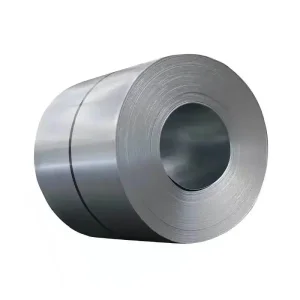
Located strategically near Tianjin Port (Xingang), our logistics network provides direct bulk and containerized shipping access to global maritime routes. Coils undergo specialized export packaging featuring anti-corrosion VCI paper, heavy-duty radial steel straps, eye-vertical or eye-horizontal wooden skids, and moisture-proof outer metal jackets engineered to withstand transoceanic humidity changes.
Global Procurement Needs & Intent Analysis
How international transformer original equipment manufacturers (OEMs) and grid operators reduce lifecycle energy losses while maintaining procurement agility.
Global power distribution modernization, driven by the global energy transition, renewable grid integration, and AI data center electrification, has intensified demand for high-grade electrical steel. Procurement decisions are no longer governed solely by upfront coil prices per metric ton; modern procurement strategies incorporate full life-cycle operational expenditure (OpEx) modeling.
EcoDesign Tier 2 Compliance
European Union EcoDesign Directive (EN 50708) and US Department of Energy (DOE 2016/2021) standards enforce stringent maximum load and no-load loss limits on transformers. Sourcing high-permeability CRGO steel (e.g., 23HiB or laser-scribed 0.23mm grades) allows transformer OEMs to pass regulatory thresholds without increasing core cross-sectional mass, saving both copper wire and insulating oil volume.
Noise Level Mitigation
Magnetostriction—the physical deformation of silicon steel crystals under alternating magnetic flux—is the root cause of transformer acoustic hum. Premium grain-oriented coils with inorganic tension coatings exert compressive stress on the steel surface, suppressing magnetostrictive expansion and reducing acoustic emissions by up to 5 to 8 dB(A), crucial for urban substation installations.
Slitting Precision & Stacking Factor
B2B buyers require minimal edge burr during coil slitting (<0.02mm) to prevent interlaminar shorts in stacked transformer laminations. High flat-rolled accuracy yields a stacking factor (lamination factor) exceeding 96.5%, ensuring compact magnetic core structures, reduced stray flux leakage, and higher power density.
Localized Application Scenarios & Case Studies
Tailored electrical steel solutions optimized for ultra-high voltage power transmission, industrial motors, and renewable energy conversion systems.
1. Power Grid Transformers (EHV & UHV)
Scenario: 500kV and 750kV Extra-High Voltage step-up transformers for regional power transmission.
Material Choice: 0.23mm to 0.27mm Laser-Domain Refined High-Permeability CRGO (e.g., 23QG085).
Engineering Impact: Achieves low core losses under high flux densities (1.7T to 1.8T), enabling grid operators to maximize transmission efficiency while adhering to strict weight limits for transport over bridges and mountainous terrain.
2. Distribution & Renewable Step-Up Substation Cores
Scenario: 11kV/33kV pad-mounted distribution transformers in solar PV farms and wind turbine towers.
Material Choice: Standard CRGO Coils 0.27mm or 0.30mm (e.g., 27Q120, 30Q130).
Engineering Impact: Provides exceptional thermal stability under cyclic harmonic loadings caused by solar/wind power inverters, offering cost-effective durability over a 30-year operational life.
3. High-Efficiency EV Traction Motor Stators (CRNGO)
Scenario: High-speed drive motors for electric passenger vehicles operating up to 18,000 RPM.
Material Choice: Ultra-thin Cold Rolled Non-Grain Oriented Coils 0.25mm to 0.35mm (e.g., 35NO210).
Engineering Impact: Lowers high-frequency eddy current losses during rapid motor acceleration, enhancing EV driving range per charge cycle and reducing heat buildup within motor stators.
4. Industrial Motor Remanufacturing & Stampings
Scenario: IE3/IE4 premium efficiency industrial induction motors for pumps, fans, and compressors.
Material Choice: Standard CRNGO Steel Coils M310, M350, M470.
Engineering Impact: Delivers exceptional magnetic permeability and punching suitability, extending punch die life while meeting stringent industrial motor efficiency benchmarks.
Global Compliance & Localized Technical Support
Ensuring end-to-end traceability, international certification compliance, and localized engineering assistance for international import requirements.
International Standard Alignment
All cold-rolled electrical steel coils are manufactured in strict compliance with global technical standards including IEC 60404-8-7, EN 10107, ASTM A876, and JIS C2553. Mill Test Certificates (MTC) conforming to EN 10204 3.1 or 3.2 are issued with every shipment, detailing exact chemical composition, core loss curve profiles, magnetic induction levels, and thickness tolerances.
CBAM & Environmental Compliance
To assist European buyers under the EU Carbon Border Adjustment Mechanism (CBAM) and global sustainability mandates, our production facilities track embedded carbon emissions through energy-efficient EAF and scrap-supplemented converter pathways. Coils comply fully with EU REACH and RoHS environmental directives regarding heavy metal limits in insulating surface coatings.
Localized Slitting & Inventory Hubs
We offer OEM toll slitting services to reduce local processing waste for transformer core winders. Coils can be pre-slit into custom strip widths from 20mm up to 1000mm with precision burr control. Flexible inventory consignment and local warehousing support allow procurement teams to streamline lead times and mitigate global ocean freight disruptions.
Future Trends in Electrical Silicon Steel Manufacturing
Key technological shifts shaping next-generation magnetic materials for smart grids, high-frequency power electronics, and sustainable energy.
1. Ultra-Thin Gauges (≤ 0.15mm)
As operating frequencies in EV inverters and high-frequency transformers increase from 50Hz/60Hz to several kilohertz, standard gauge steels experience severe eddy current losses. The industry is moving toward commercial production of 0.18mm, 0.15mm, and 0.10mm ultra-thin CRGO and CRNGO silicon steels to maintain efficiency in high-speed power conversion applications.
2. Advanced Laser Scribing
Next-generation non-contact laser scribing uses ultrafast laser pulses to create refined domain structures without damaging surface insulating coatings. This technology reduces core losses in high-permeability oriented steel by an extra 8% to 12% compared to conventional mechanical scratching or plasma-jet treatment.
3. Self-Bonding Coatings
For electric vehicle motors, traditional interlocking or welding of motor stator laminations introduces thermal stress and magnetic degradation. Advanced self-bonding varnish coatings (Backlack) allow stacked laminations to bond thermally during low-temperature baking, maximizing core magnetic permeability while drastically reducing acoustic noise.
4. Hybrid Amorphous Cores
While amorphous metal alloys offer ultra-low no-load loss, their low saturation induction (1.56T) requires bulky transformer sizes. Research into hybrid core structures combining high-permeability CRGO steel with amorphous alloy ribbons aims to balance volumetric compactness with extreme energy efficiency in distribution transformers.
Frequently Asked Questions (Q&A)
Expert insights addressing critical technical, commercial, and logistical queries from international buyers of electrical silicon steel coils.
- C-3: Organic coating used on CRNGO steel to enhance punchability and tool life during high-speed motor lamination stamping.
- C-5: Inorganic phosphate coating with high thermal resistance (withstanding stress-relief annealing up to 800°C). Standard on CRGO steel, providing both electrical insulation and surface tension to lower core losses.
- C-6: Semi-organic coating offering high insulation resistance and good weldability for specialized motor cores.
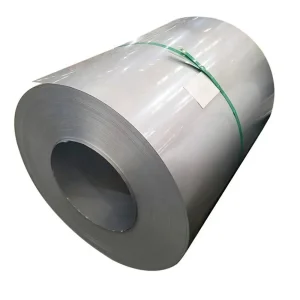
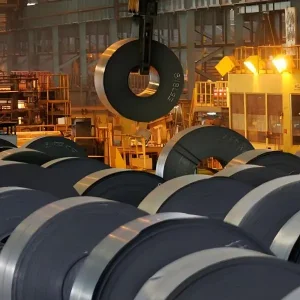
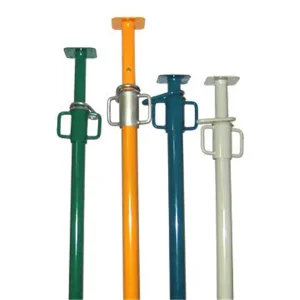
Coated Coils, Special Alloys & Structural Products
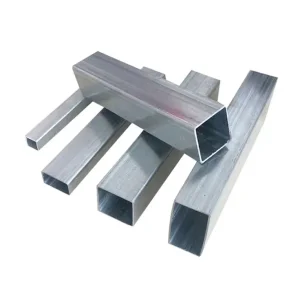
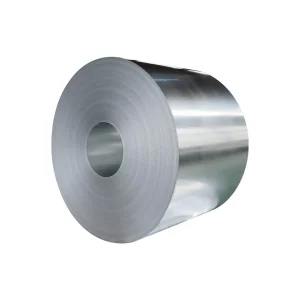
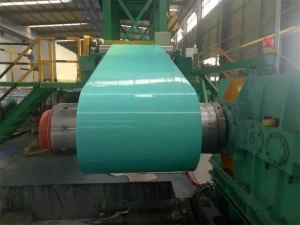
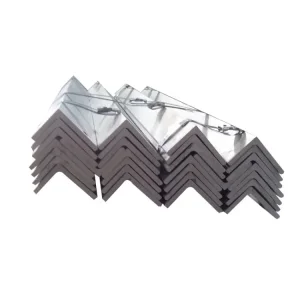
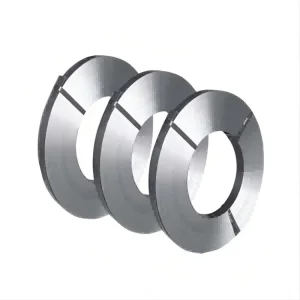
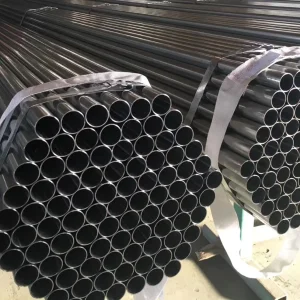
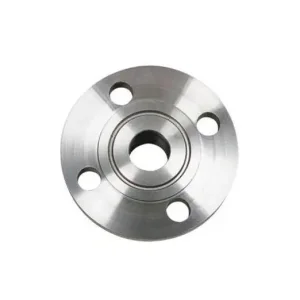
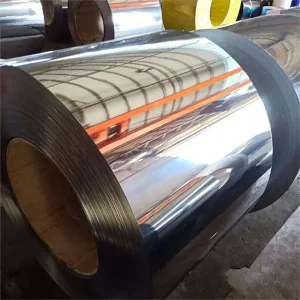
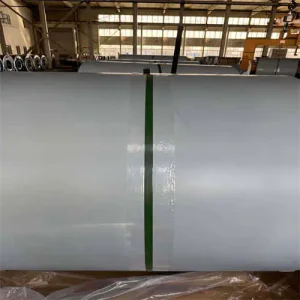
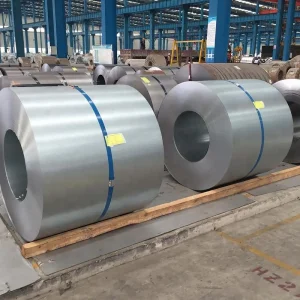
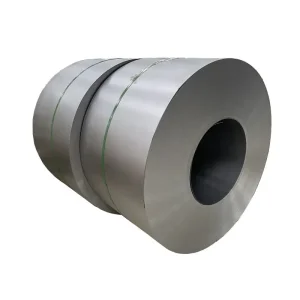
Explore additional mill-direct product categories, including aluminized silicon coils, tinplate, stainless steel, and galvanized structural items.
Request Mill-Direct Specifications & Quotations
Connect directly with our metallurgical engineers and international procurement team for coil slitting options, custom steel grades, and bulk export pricing.
Mill Test Certificates (MTC)
Receive full material traceability reports conforming to EN 10204 3.1, including B-H hysteresis curves and core loss data ($P_{1.7/50}$) for your specific transformer design requirements.
Custom Slitting & Toll Processing
High-precision coil slitting from 20mm strips up to full 1200mm master coil widths with burr heights under 0.02mm, packaged for immediate automated core winding.
Global Logistics & Trade Terms
Supporting FOB Tianjin, CIF destination ports, or DDP deliver terms under LC 30/60/90 days or TT payment structures. Seaworthy anti-corrosion packaging guaranteed.