Featured Industrial Steel Solutions & Core Offerings
Precision-engineered electrical, structural, and coated steel products supplied directly from state-of-the-art Chinese manufacturing facilities to global infrastructure and OEM projects.


1. Global Commercial & Industrial Status of Non-Grain Oriented Electrical Steel (CRNGO)
Cold Rolled Non-Grain Oriented (CRNGO) electrical steel represents the metallurgical backbone of the modern electrified economy. Unlike Cold Rolled Grain Oriented (CRGO) steel—which exhibits strong magnetic anisotropy optimized almost exclusively for static step-up and step-down transformers—CRNGO possesses isotropic magnetic properties within its rolling plane. This uniform magnetic permeability in all 360-degree planar directions makes CRNGO indispensable for rotating electrical machinery, including electric vehicle (EV) traction motors, industrial induction motors, hermetic compressor units, and renewable energy generators.
Electromagnetic Physics & Loss Dynamics
The operational efficiency of rotating electrical machines depends on minimizing core loss (total iron loss, $P_T$). Core loss is categorized into three primary physical phenomena:
- Hysteresis Loss ($P_h$): Energy dissipated during the cyclic domain wall movement and magnetic dipole rotation. Controlled via high chemical purity, ultra-low carbon ($C \le 0.003\%$), and coarse grain size after final annealing.
- Classical Eddy Current Loss ($P_e$): Induced circulating currents governed by Faraday's Law. Mathematically proportional to the square of sheet thickness ($d^2$) and operating frequency ($f^2$). Reduced by thinning laminations (e.g., from 0.50mm down to 0.20mm/0.15mm) and increasing electrical resistivity ($\rho$) via Silicon (Si) and Aluminum (Al) alloying.
- Anomalous/Excess Loss ($P_a$): Domain wall interaction losses resulting from microstructural inhomogeneity, mechanical residual stress, and grain boundary drag.
Global Supply Chain & Mill Tiering
The global CRNGO market exceeds 14 million metric tons annually, with production concentrated in tier-1 fully integrated steel mills in China, Japan, South Korea, and Western Europe. Advanced manufacturing demands vacuum degassing, ultra-precise tandem cold rolling mills equipped with automatic gauge control (AGC), and continuous decarburization/annealing lines (CAL) capable of sub-micron atmosphere control ($H_2/N_2$ dew point management).
Leading Chinese manufacturers have achieved massive technological leaps, closing the gap in high-frequency, ultra-thin high-induction grades required by global tier-1 automotive supply chains and high-efficiency motor OEMs.
2. Global Macro Industry Trends Driving Non-Grain Oriented Electrical Steel Demand
The global energy transition, coupled with stringent international regulatory frameworks for industrial motor efficiency (such as IEC 60034-30-1 IE3/IE4/IE5 standards and US NEMA Premium efficiency rules), has fundamentally shifted the demand spectrum for electrical steel toward premium-tier, ultra-low-loss CRNGO grades.
E-Mobility & EV Traction Motor Electrification
Traction motors in modern battery electric vehicles (BEVs) operate at speeds upwards of 18,000 to 22,000 RPM, translating to fundamental excitation frequencies between 400 Hz and 2,000 Hz. Standard industrial steel (0.50mm thickness with $P_{1.5/50} \sim 5.0$ W/kg) suffers severe thermal breakdown under these high frequencies.
The EV boom necessitates high-frequency, high-induction CRNGO grades (gauges 0.20mm, 0.25mm, 0.30mm) engineered with ultra-high $B_{5000}$ induction values to maximize inverter range and torque density.
IE4 / IE5 Super-Premium Efficiency Motors
Industrial electric motors consume approximately 45% of global electrical energy. Regulatory bodies worldwide have made IE3 mandatory, with IE4 (Super Premium) and IE5 (Ultra-Premium) rapidly becoming market baselines in Europe, North America, and East Asia.
Transitioning a motor design from IE2 to IE5 requires swapping low-silicon structural grades (like M800-50A) for high-silicon, low-loss grades (such as M270-35A or 35NO270), directly driving unit consumption of refined CRNGO.
Heat Pump & Inverter Compressor Surge
Variable-speed HVAC heat pumps and smart hermetic air-conditioning compressors demand variable-frequency motor operation. Lower loss electrical steel directly reduces thermal dissipation within sealed refrigeration units, enhancing overall seasonal performance factor (SEER/SCOP) values.
3. Electromagnetic & Mechanical Performance Benchmarks
Standardized comparative analysis of standard vs. premium non-grain oriented electrical steel grades according to IEC 60404-8-4 and ASTM A677 specifications.
| Standard Grade (IEC / EN) | Nominal Thickness (mm) | Max Core Loss $P_{1.5/50}$ (W/kg) | Max Core Loss $P_{1.0/400}$ (W/kg) | Min Magnetic Induction $B_{5000}$ (Tesla) | Primary Industrial Application |
|---|---|---|---|---|---|
| 20NO1200 | 0.20 | 1.15 | 12.0 | 1.62 | EV Traction Motors (>15,000 RPM), Aerospace Rotors |
| 27NO1100 | 0.27 | 1.10 | 14.5 | 1.64 | High-Speed Hybrid EV Motors, Drone Motors |
| 35NO300 (M270-35A) | 0.35 | 2.30 - 2.70 | 24.0 | 1.66 | IE4 / IE5 Industrial Motors, Servo Motors |
| 50NO470 (M470-50A) | 0.50 | 4.70 | 55.0 | 1.70 | Standard Industrial Pumps, Fans, General Induction Motors |
| 64NO800 (M800-64A) | 0.64 | 8.00 | 85.0 | 1.73 | Home Appliance Motors, Small Fractional HP Motors |
4. Localized Application Scenarios & Operational Engineering Requirements
Selecting the exact CRNGO grade requires balancing high magnetic flux density ($B$), low core loss ($P$), mechanical yield strength ($\sigma_y$), and surface insulation resistance.
A. Automotive Traction Motor Stators & Rotors
Operating Environment: Frequencies up to 2,000 Hz, severe high-speed rotational centrifugal stress, oil-cooled or direct refrigerant spray cooling environments.
Selection Criteria: Gauges from 0.25mm down to 0.20mm. Rotor slots require high mechanical yield strengths ($\ge 420 \text{ MPa}$) to prevent slot bridge deformation under high centrifugal force, whereas stator teeth require minimum core loss ($P_{1.0/400}$) and maximum magnetic polarization.
B. Industrial Premium Pumps & Heavy-Duty Compressors
Operating Environment: Continuous 24/7 industrial duty cycle, grid frequency (50 Hz / 60 Hz) or VFD-driven excitation.
Selection Criteria: Gauges of 0.35mm or 0.50mm (e.g., M330-35A or M400-50A). High stacking factors ($\ge 96.5\%$) and precise, stress-free slitting edges (< 15 $\mu$m burr height) to maintain nominal magnetic cross-section and prevent interlaminar short circuits.
C. Hermetic Refrigeration & HVAC Compressor Motors
Operating Environment: Submerged in synthetic ester/polyolester oils and freating synthetic refrigerants (R134a, R32, R600a) at elevated temperatures.
Selection Criteria: C-5 or C-6 organic-inorganic hybrid insulation coatings tested specifically for zero chemical leaching, high solvent resistance, and high burn-out temperature resistance.
5. Technology Roadmap & Future Outlook (2025–2035)
The next decade of electrical steel research and factory production focuses on grain texture engineering, advanced bonding technologies, and ultra-thin rolling capabilities.
1. Crystallographic Texture Optimization ($\{100\}$ Cube Texture)
Standard CRNGO exhibits a isotropic distribution of grain orientations. However, the ideal magnetic state for rotating machines is a pure $\{100\} \langle uvw \rangle$ crystallographic cube texture where the easy magnetic axes ($\langle 100 \rangle$) lie completely within the plane of the sheet. Advanced mill hot-rolling and warm-rolling thermal profiles, combined with phase transformation control, are achieving record $\{100\}$ grain fractions, boosting magnetic permeability by over 20%.
2. Self-Bonding Varnish Technology ("Backlack")
Traditional lamination stack joining methods—such as interlocking, welding, or cleating—introduce severe thermal and physical residual stresses that degrade magnetic permeability and increase local core loss by up to 30%.
The future lies in full-surface Backlack self-bonding coatings. Applied at the mill as a B-stage coating, laminations are heat-cured under pressure during core assembly. This yields a monolithic, completely stress-free magnetic core with superior dampening against acoustic noise and vibration.
3. Ultra-Thin Gauges & Additive Magnetic Manufacturing
Pilot lines are now cold-rolling silicon steel down to 0.10mm and 0.08mm gauges for ultra-high-frequency aviation motors. Simultaneously, soft magnetic composite (SMC) materials and 3D additive printing of non-grain oriented magnetic cores are emerging for complex 3D flux motor topologies (such as axial flux motors).
6. Macro Industry Solutions & Factory Procurement Strategies
How enterprise buyers, motor OEMs, and stamping factories mitigate processing degradation and secure reliable quality from Chinese manufacturing partners.
Slitting Burr & Mechanical Stress Control
Precision slitting is critical. High edge burrs (> 15 $\mu$m) cause interlaminar electrical shorts across lamination stacks, triggering massive eddy current hot spots. Modern factories utilize ultra-hard tungsten carbide slitting knives, optical laser blade alignment, and automatic tension control to ensure clean, burr-free coil slitting with minimal edge deformation zone width.
Stress Relief Annealing (SRA) Best Practices
High-speed punch stamping introduces plastic strain hardening along lamination cut edges, creating a magnetically "dead" zone up to 1–2 mm wide around every slot. For un-annealed (fully processed) grades, executing a post-stamping Stress Relief Annealing cycle in a dry nitrogen/hydrogen protective atmosphere at 750°C–780°C restores magnetic domain mobility and fully recovers original mill loss guarantees.
Corrosion Protection & Global Logistics
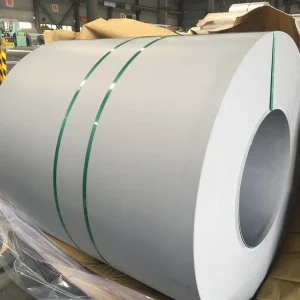
CRNGO coils are highly susceptible to atmospheric moisture and ocean freight humidity. Leading Chinese factories mandate multi-layer Vapor Corrosion Inhibitor (VCI) paper wrapping, galvanized steel outer casing, rubber edge protectors, and desiccants within sealed wooden cradles engineered specifically for multi-month maritime transport.
7. Frequently Asked Questions (FAQ) - Non-Grain Oriented Electrical Steel
Expert answers to technical procurement, processing, and metallurgical questions for motor design engineers and sourcing managers.
Q1: What is the fundamental metallurgical difference between CRNGO and CRGO steel?
The primary difference lies in grain orientation and magnetic symmetry. CRGO (Grain Oriented) undergoes specialized multi-stage cold rolling and secondary recrystallization annealing to align over 90% of its iron crystals in the (110)[001] "Goss texture" direction, making it extremely magnetic in the rolling direction but poor in other directions—ideal for stationary transformer cores. CRNGO (Non-Grain Oriented) undergoes controlled recrystallization to produce a isotropic planar crystal texture with uniform magnetic properties in all directions, making it essential for rotating machinery like electric motors and generators.
Q2: How does Silicon (Si) content affect the physical properties of electrical steel?
Adding Silicon increases the electrical resistivity ($\rho$) of the iron matrix, which directly suppresses classical eddy current losses ($P_e$). Silicon also decreases magnetostriction, reducing magnetic noise. However, increasing Silicon beyond 3.5% drastically embrittles the steel, making conventional cold rolling difficult. Advanced mills use precise Silicon and Aluminum alloying (up to ~1.0% Al) to optimize resistivity while maintaining cold-rolling ductility.
Q3: What insulation coating classes are specified under IEC and ASTM standards?
Standard coating designations include C-3 (organic coating for improved punchability and tool life), C-5 (inorganic-organic hybrid coating offering high insulation resistance, thermal stability up to 750°C for stress relief annealing, and chemical resistance), and C-6 (heavy inorganic coating for high pressure/temperature duty). Self-bonding "Backlack" coatings represent the premium tier for high-frequency low-noise motor cores.
Q4: Why is lamination thickness reducing in modern EV traction motors?
Classical eddy current losses scale with the square of frequency ($f^2$) and square of sheet thickness ($d^2$). Since EV motors operate at fundamental excitation frequencies between 400 Hz and 2,000 Hz, reducing lamination thickness from 0.50mm to 0.20mm reduces eddy current loss by over 80% at high rotational speeds, directly expanding electric vehicle battery range.
Q5: What are the key quality verification tests during factory inspection?
Standard factory test certificates (EN 10204 3.1) must verify: 1) Core loss ($P$) and magnetic polarization ($B$) using an Epstein frame or single-sheet tester (SST); 2) Precise gauge tolerance and cross-sectional crown; 3) Insulation resistance (Franklin tester per ASTM A717); 4) Stacking factor (interlaminar space factor); and 5) Surface burr height on slit coils.
Expanded Industrial Steel Product Portfolio
Factory-direct flat rolled products, structural pipes, specialty alloys, and tinplate solutions engineered for global commercial applications.